The Spiraling Homestead

Saturday, June 20, 2009

Rose Petal Jelly

Rose petal jelly. Doesn't sound like that big of a deal, does it? Maybe it isn't, depending on the rose you make it with.

But WOW, when you make it with a 7-sisters rose, you know you've got something!

First - the 7-sisters rose...

Named in 1817, supposedly when it was brought over from an unknown country - some say China, some say England, it was an instant hit.

There is also great controversy regarding what type of rose it is. It has no fewer than 12 latin names that it can be called. That's confusion. LOL

Regardless, it's the hardiest rose I've ever seen. It rarely gets black spot - it may this year with all of the rain we're getting so early, but maybe not. It almost never gets aphids. They try, but they never succeed in infesting it. It tolerates significant drought, shade and poor soil. It's not quite a climber, so most will call it a rambling rose.

The name comes from its ability to have at least 7 different colors on a single stem or spray. This year we even have some white blooms - rare for her. As you can see, the shades might be subtle, but the blooms also might be striped as you can see from the bloom in the lower right side of the photo. They are anywhere from 1-3 inches across, double petals and wonderfully scented!

For this project, I decided to use old blooms where the petals were ready to fall from the bloom. I just can't sacrifice such beauty and incredible scent just to try something. And from the results, I don't need to! WOW!
As you can see from the color of the rose water, something chemical occurs to change the color of the petal to the rose water. Most likely acid in the pectin and lemon juice. The smell when making the rose water is just divine. Actually, the smell throughout the process is just divine. Just incredible.
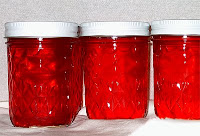


The recipe I made was a 1:1 sugar to rose water ratio. Make it as you would any jelly, and you get about 4 half-pint jars. The pictures are from my first batch. Is this just the most gorgeous jelly you've ever seen? You can practically read through it! If it weren't for the distortion from the jar glass, you probably could!

One thing I've yet to master with this rose is propogating it. This year, just for grins, I stuck some of the prunings in the ground. Just shoved them in. I did nothing else to them. Whenever I have, it hasn't worked, so I figured I'd do it this way. It worked! At least thus far. They all have some roots, so I transferred them to a more ideal location with far better soil and that is more like the mother plant's location. So, we'll see.

Can you believe this jelly sells for over $1/oz, plus S+H? I'm not selling mine for nearly that much. It's not as little as my rhubarb, but it's not a buck an ounce either!

Tasting it is like truly capturing the smell of a rose. It lingers on your tongue the way you wish smelling one would. Just incredible. It's perfect for those days in december when you are holding to the hope that June truly will return again. Wow.

If you'd like to try some, please contact me. I'll be making at least 2 more batches. The smallest jar is 4 oz at 2.75. The 8 oz is 6. I'll figure out shipping individually. And if you live nearby, it just might be free!
BloomsBaker @ gmail.com
I broke the link, so take the spaces out to make it work right for you.

Labels: , ,

Sunday, April 12, 2009

A Day In The Life Of

Chickens.

LOL

You'd be surprised at the number of people who have never seen chickens doing what they do best - forage.

The only pictures or videos seen anymore are of chickens in huge barns, all white, except where other chickens have crapped on them, just milling about.

Chickens do a lot more. They're great for insect control, removing thatch from a yard, fertilizing, egg laying, and of course, eating. They're also a great source of entertainment.

Since I grew up around chickens, it was pretty easy to see my brother's flock doing their thing. But trying to convey this to our friends who've never been around chickens was another thing entirely. So, I asked my brother to take a video. And now he's looking at getting a chicken cam.

LOL - I'll put a link to it when he gets one set up.

Until then, enjoy this video. You can hear them clucking and talking to each other. Just don't jack the volume up too much since the rooster does crow. Twice.


Video Link

And for more - the history of these chickens:
The First Chickens
The Coolest Chicken Coop
Their First Day In The Wild Green Yonder

Labels: , , , ,

Tuesday, March 24, 2009

Talk about Reuse!

This past week has been pretty hectic at my brother's place.

As you know, he already has some chickens
Well, he didn't just triple his flock, he quintupled it! Rhode Island Reds, and he seems pretty proud of them. Pullets - so they aren't laying eggs yet, but he figures in about 6 weeks, they'll be laying a combined 3.5 dozen a day. Salada Eggs!

When he got them, he wasn't anticipated expanding just yet, or to the degree in which he expanded. So he needs a super duper fast "egg mobile" as he calls it. He had been talking about making a more portable coop, so he can give them new foraging as often as they need, but hadn't worried about it just yet. He's worrying!

So in I step, suggesting he ask our neighbor for her ancient pop-up camper that's been parked for over 20 years. Dad called, and he was told that if bro could come and get it, it was his! He was down the next day. LOL

We were all certain that thing would be ruined inside. We were wrong! The tires hold air, the stoves works, the ice box is cracked, there's virtually no mildew and hardly needed airing. Uh oh. He's also been talking about something like this for a spare bedroom too. Now what? The chickens are here NOW, so it's the latest and greatest in chicken coops. Talk about Haute Poule. These babes are it!

So, he's in the process of gutting the camper. The stove already has a new home, and the other things are still in search of somewhere useful to live. Once we have pictures, they'll be posted.

It's a wild and wacky world around me, that's for certain.
New pictures! LOL
It's a topless camper!

Labels: , , ,

Thursday, March 19, 2009

My Brother's Chickens

3/19/09 - Well, he's at it again. He's tripling his "herd" (I know, flock. But I'd like to call him a chicken herder. LOL). Today he's going somewhere down in PA to get another 20 chickens. Don't know if they're the same breed as what he has now, but he's getting more. He has the demand for eggs, and he has plenty of property to put them on, so he might as well increase his population.

Good for him!


And here's a picture of his chicken coop in action, with chickelfinks attached. He couldn't decide which to put on the 'back' of the coop, so both went on the 'front'.


The spring of 2008 had a neighbor of my brother bring him some chicks and proclaimed him a chicken farmer.

Naturally, my brother kept them and, has indeed, begun his chicken farming stage of life.

These chickens are Plymouth Rock - barred variety. Who knew there are 7 varieties of Plymouth Rocks out there?


Naturally, once fall came, he had to build them a coop. Being the over-engineering sort, and plenty of wood to harvest as lumber, he made them a COOP. Those chickens have no clue how good they have it. As you can see, it's a 2-story coop. And it's portable! He can move it with his tractor to new foraging whenever he wants. The chickens apparently love it when they move and come out to watch the tractor whenever he starts it up. The second floor has roosts and nesting boxes that you can access from the outside with a hinged portion of the roof. Easier egg gathering and cleaning - no bending!

Once I saw the design, I was driven to make him some distelfinks. Only - distelfink for a chicken just doesn't sound right - so, I totally bastardized the concept and called them chickelfinks. I've not gotten any pictures of them on the coop, but I'm sure I'll get one someday. Obviously, I took great liberties with the second one. However, for chickens, it just seemed incredibly appropriate! The first is far more traditional, using standard symbols and colors. The only non-standard part is the rooster instead of a finch.


The amazing part is, these chickens are already laying eggs! I figured early spring would be the soonest, but they're doing quite well - especially for pullets (hens less than a year old. The rooster is a cockerel until he's a year old - then he's a cock).

A little tidbit I found while doing my turkey farming research is that chickens with white earlobes lay white eggs and chickens with red ear lobes lay brown eggs - with a few exceptions.

First - WHO knew chickens had earlobes and WHO looked?

And if they lay speckled eggs, is it because they have freckles on their earlobes or what?
Ah well, that little bit of pondering will have to wait for another day. So do they have varying shades of red earlobes? And the 2 eggs on the far right are speckled - freckled earlobes? If they lay consistently the same shade/tone, we have eggs from 4 different hens. But, I don't know if they do lay consistently or not. Such research to do!

I honestly don't know what my brother will do with all of his eggs. I've offered up different people within my circle who would love to buy them, but I've not hear. He may already have them all spoken for. But considering he'll be getting an average of 2 per day from each hen, that's 20/day to get rid of. LOL Just a few.

Labels: , ,

Wednesday, March 18, 2009

Maple Surple


Roses are red
Violets are purple
Sugar is sweet
So is maple surple.

Anyway, a long story for 2 pints of syrup.
I had to move all of our firewood away from the south wall of our garage because I have to 'install' (read, DIG) a drainage ditch/culvert/trench. The water along the E/NE wall is making moss grow on the radio shack (don't ask about the radio shack. I lost in the vote to get rid of it). So - moved the firewood. As I was finishing the second day of hauling and tossing, I noticed the maple nearby was dripping. I knew the sap was running, but it's always good to have that affirmation

If you've never had plain sap, it's one of those 100 things to see/do before you die. Wonderful! So, I started wiping up the drops from cleaner pieces of wood (anything not dirt) and tasting. WOW is it sweet! I've had sap before, but none this sweet straight from the tree. I had Dad try it and he thought the same thing. So, I said to him - find me a tap and I'll make some syrup.

Never mind I've not made it before and that it's very late in the season. While I was moving the wood, I had been thinking I would try it next year. Well, what's a year among friends, right?


He trotted right off to find one. It took him an hour, but he found one! And while he was gone, I was online searching out exactly how to do this thing, tapping a maple tree. First off, the hole they suggest you drill is PUNY. 5/16. Right! I had to up it to about 7/16 because the tap just wouldn't even start. But, with it that little bit bigger, I was able to coax it in without splitting the tree.

I got a gallon in 4 hours. Wow! Fast! It has slowed considerably since then. Now I might get a gallon in about 8 hours. But, that's ok. I've already exceeded my hopes of how much syrup I'd get.

The set up now isn't nearly as picturesque as it used to be - the slightly beat up bucket hanging under the tap, with the sounds of the drips quietly coming from inside. It's a plastic bag. Ew. But, effective. And bungy cords. Where has the beauty gone in our lives? Sigh. But, again, effective.

All of the sites I looked at said the ratio is 40:1. You need 40 ounces of sap to get 1 ounce of syrup, 40 gallons to get 1 gallon, etc. They also said the average tap would yield 4-10 gallons of sap before drying up. So I figured if I could get 5 gallons of sap, I'd be a happy camper. It is a full month into the season and I have no clue how much difference that makes in the volume or how long a tap lasts.

So, I've been boiling a gallon of sap at a time on top of our kitchen stove. You know how they show piles of steam just rolling off like fog? Not with a mere spit of a gallon. It's like you're making spaghetti for a couple of hours. That's not much steam at all. So, I boil it down from a gallon to a cup. I thought I'd do this until I was finished collecting sap, and then boil down all of it at once.

Well, I didn't feel like having that many jars of partial syrup/sap around. So last night, I took my 2 pints of boiled down and started to boil it down again. I had only collected around 3.5 gallons, so figured I'd be lucky to get a cup of syrup from the 2 pints. When it was finished, I had 1 pint plus 3 ounces. I knew the sap was sweet, but holy crow! That's a significant difference from the average.

And considering this maple is a hybrid - it's not a red maple and not a sugar maple - I figured it would take more boiling. So maybe I've got something here in this hybrid! I'll know next year when I try this again.

I'm probably going to pull the tap tomorrow after the morning collection. I've got enough for us and now I know it's not some hocus pocus years of trial and error thing that you only master after 20 years. I have 4 maples on the property I can tap, plus 2 on the neighbor's property. Plus, there are 2 box elders that I can tap as well. And I may next year. It's said they aren't as sweet and don't have as much of the quintessential mapleness to them. Mom hates maple, so she might like it. We'll see.
It's been fun! And not hot or sweaty or steamy. I'm pretty happy with it. And it tastes wonderful! WOW.
This is a picture from last fall - early September. It's the tree on the right with no leaves on it. It's a strange beast - it's always done that. It changes from top to bottom - as does another on the property, but it changes early and loses them as soon as they change color. The others hold the leaves for far longer.

Labels: , ,

Tuesday, August 26, 2008

August Update

Wow, what a whirlwind the last few weeks have been!
Our freezer is stuffed!

Besides the 3 bags of bought veggies on the top shelf, it's all corn. 50 pints and 2 quarts.

Second shelf is summer squash, string beans and Swiss chard.

The third shelf is stuff that wouldn't fit on the second shelf, along with home made broths, spaghetti sauce, soup and the ice cream.

The bottom shelf is about 20 quarts of blueberries from our 5 bushes (about 16 quarts have been given away this year), plus 1 quart of peaches, in case we need to make a pie. The rest of the peaches have been canned. The door is blueberries and veggies for my sister to take with her each time she comes to visit.

I even have a little space on the third shelf! Woo!


These shelves aren't complete yet. I still have tomatoes and applesauce to can. I'll be finished with them by mid October.
First shelf is pickles - 2 kinds of sweet, and jam.
Second shelf is allllll peaches.
Third shelf is a mix of peaches (that didn't fit on the second shelf), B&B pickles, and kosher dill pickles.
Fourth shelf will be allll tomatoes.
Bottom shelf - apple sauce most likely.
Or, I'll rearrange. We'll see. The shelf unit is 4' wide x12"deep x5'high. We also have shelves in our laundry room that will hold a few jars of each as a pantry.
I've also made a lot more jam than what's on these shelves. By making it and selling it very cheaply to friends, I was able to completely pay for the bushel of peaches I bought. Hopefully I'll be able to continue this each year to pay for small things.
Now, if we had to survive on what I'm putting up this fall, we'd live about 3 months. We have another refrigerator freezer full of meat, and the fridge is filling with dried beans, flour, rice, barley, corn meal, etc. It might as well live in there and keep the fridge from running as much, as live on a shelf taking up space for no reason.
I know we wouldn't live very long, but I'm not that much of a pessimist about life. At least not yet. I may get to the point of truly homesteading and preserve all of my own food. But for now, this is what I can handle. A very full freezer, a filling fridge, a filling shelf unit and a full pantry.
I do have to say, living like this certainly isn't the worst life has to offer, and is something I'm truly enjoying. Definitely there are worse ways to live than to stay physically busy growing and preserving your own food, cutting your own heat, and making do with what you have. I've always preferred a simpler way of life, and so this isn't a difficult adjustment for me to make from having worked full time to being disabled with constant vertigo.

Labels: , ,

Saturday, February 2, 2008

A Near Record Buck

I have to talk up my cousin.
He hunts. He eats it, processes it himself, does it all as humanely as possible. He's a good guy.
Well, he saw NO deer throughout the season, so finally decided to come up and install our new floors (he's a carpenter).
He got one floor done and 2 days later, shot a doe. Big doe! He was thrilled!
Finished butchering her and came to install the second floor.
Finished the second one and shot another deer. A Buck. A Big Buck. A near record buck.

156# field dressed.

Here, in his own words, is the full story of the hunt.

THIRD TIME’S A CHARM

It was December 15, 2007; a day that I thought would be the last good day to hunt the NY muzzleloader season, with a nor’easter moving in the next day.

My season had been poor, having not seen a buck since the beginning of regular season a month before. When the alarm went off, I toyed with the idea of staying in bed, but forced myself to get up. While eating breakfast, I still thought about staying in the warmth of the house. Instead I went to my hunting room, loaded the muzzleloader, and started putting on layers of clothes.

As I started up the driveway to my parents’ home where I hunt, I tried to decide what stand to spend my last hunt of the year in. Bringing the truck to a stop and shutting off the engine, I decided to sit in the brush lot below the house where I could overlook a creek bottom, and deciding not to climb the hill above the house. “What’s the difference?” I asked myself. I doubted I’d see a buck anyway.

I made my way to the stand and climbed the ladder to my perch above the creek. Soon after settling in I saw two ghostly shapes running through the brush in the creek bottom below. I grabbed my binoculars and locked on the shadow that has halted in the gray pre-dawn darkness. It looked like it could be buck, I thought, as the deer turned its head scanning its surroundings.

I stayed locked on the deer as it stood like a statue; just its head moving as it continued scanning the area. After 10 minutes, with the coming dawn pushing back the darkness of night, I could make out the spread of antlers silhouetted against the snow left from the last storm. My breath caught in my throat as its head turned back and forth. This was the widest rack I had ever seen while hunting. Minutes passed and soon it was light enough to see the long tines moving against the white background. Now, my heart was pounding!

It had been almost one-half hour since I saw him moving down the creek, and it was now legal hunting hours. He hadn’t moved 30 feet in this period of time and continued to check his surroundings. I estimated the yardage at 120 yards and, as I looked through the scope, agonized over whether I should try to get down and move in closer. “There is too much brush,” I thought. As I continued to watch him, I hoped he would bed for the morning so I could move closer. After what seemed like hours, he moved about ten feet into an opening, and I brought the gun up again searching for a clear shot through the scope.


I had it, a clear shot! I pulled the hammer back on the Winchester Apex and settled the cross hairs just behind his shoulder, slowly squeezed the trigger and …. click. Nothing! “Did I forget the primer,” I curse myself, as I dropped the breech. No, there was the primer with a dent in it. I closed the breech and pulled the hammer back again. Resting the gun on the netting in front of the stand, I put the crosshairs behind his shoulder and squeezed the trigger again … click! Panicking now, I dropped the breech and wondered … “Is it so cold the hammer is frozen and not striking the primer hard enough?” With my eyes locked on the buck, I dug the primer out and put a fresh one in its place. He had still not moved. For the third time I rested the gun and put the cross hairs behind his shoulder. I closed my eyes and prayed, “God, please let this shot go off,” as I pulled the hammer back. I tell myself, “This buck has not moved in a half hour, you have a great sight picture, don’t jerk the trigger, squeeze it!” My mind wills my finger to gently touch the trigger and begin slowly squeezing it. This time there is the loud report of the muzzleloader going off. As the buck disappeared in the cloud of smoke, I thought I saw him hunch up as the bullet hit him.

When the smoke cleared, I looked to the spot where he was standing and saw only empty snow. There was a deer running through the brush and I thought, “Did I miss him?” I began reloading and saw a buck coming to the edge of the creek looking as if he wants to cross. “You and I are getting on the same playing field,” I thought as I climbed to the ground hoping to cut him off as he crossed the creek. I crawled to the top of the cliff overlooking the creek where I could be 50 yards closer to him than in my tree stand. When I got there, I peered over and scanned the creek bottom. From my vantage point, I saw a buck trying to mount a doe and yanked the gun to my shoulder looking at the deer through my scope. I could barely make out antlers and thought, “This is not the buck I shot at; I must have hit him. There is no way he would have let that rag-horn breed that doe if he was alive.” Slowly I made my way down the bank and found a spot to cross the creek.

Getting to the other side, I looked back up trying to see my stand and get a shot path. Even with my binoculars, I cannot find my stand against the background so I began zigzagging the narrow strip of land between the creek and the mud-bottomed channel running parallel to it. Soon I found huge buck tracks with slushy mud sprayed in the snow around them, but no blood. My heart sunk as I thought I must have missed him.

Continuing my search, I decided that I should get someone to help. If I sit in my tree stand, I could direct them with radios to where the buck was and figure this out. As I turned back to the creek to go for help, I saw flecks of bright red blood sprayed across the snow and my spirits soared as I thought, “I did hit him!”

I began tracking the blood and, after 30 yards, the tracks led me to the channel. I scanned the snow on the other side looking for the blood where he exited. Then I saw him, lying in the middle of the channel with half of his rack protruding out of the water, his 10-inch G2’s look like thick daggers coming off the massive beams. My aim had been true, the bullet entered just behind the right shoulder, went through both lungs, and exited at the center of the left shoulder.

“I knew he was a good buck, but I didn’t know he was this good,” I thought! He is a 140-class buck, which is pretty outstanding for my area of New York State. He is the buck of my lifetime, and he will have a place of honor on my living room wall. I have been hunting for him all my life.

Leslie here again,
This buck was large enough, that as word spread, hunters from all over the region came to see for themselves. Being a small town, the traffic was a bit much for the roads, and believe it or not, the county sheriff's department came and directed traffic!

This was a pretty big do for the area.

Labels: , ,

Friday, January 25, 2008

A Bit of Family History

I've not put the entire 4 pages in here. This was written by my Great-Aunt, Millie Coleman. It was written for her nieces and nephews, one of which is my mother. It helps explain the Coleman history as best she knew. What I find interesting is the oral history of what life was like after the Civil War...

Of course you know that Great-Grandpa Coleman, Benjamin Jackson Coleman that is, came from Orange County, NY an orphan and Uncle Ben Drake took care of him until he grew up. There are still relatives in Goshen, NY, but probably several times removed. I have heard that at the time he came, it was be toll road and they put up at the blockhouses.

Now, in the old days, the road that goes up from Barton on the East side of the bridge was called Coleman Road. The reason being that several Colemans, and I believe they were brothers and cousins, about 8 or 10 of them, lived on that road and that is where your Grandfather, Curtis Joseph was born. In one of those houses.

Now, your great-grandmother Jane Anne Coleman was born a Catlin and she was also brought up by a relative, called Aunt Clyminnie. Her father, Joseph Catlin, was married three times and had three families. I guess it got a little too much for him, so he allowed some of them to go to live with less fortunate relatives.

Aunt Clyminnie was probably very good to her except that she was not allowed to where her shoes to and from church, just in church and she always had to carry chip dirt from the woodpile to put around the currant bushes. Grandma said that Aunt Clyminnie always had very nice currants.

Now, I don’t know how Great Grandma and Great Grandpa met, but probably at a square dance or a raising or husking bee. I don’t think they had roller skating rinks in those days. But anyway, they were married and at the horning bee, someone fired a gun in front of the window where they were standing and scared Grandma in a “fit” and for the rest of her life she was afflicted with these spells. In fact they felt that when she died she had had one and fallen into a pool of water at the foot of the cellar stairs where Uncle Jed, her son, found her when he came from doing the morning chores.

When they were first married, they went to live in a small house on Coleman Road, the first house up from the corner where the Ross Hill Rd comes out on the Barton or Coleman Rd. When your grandfather, Curtis, was about 8 years old, they moved over on the ‘crick” in Beaver Meadows on the Halsey Valley Rd. They cleared the land and built the house and barn. I remember Grandpa Curt telling about the snow blowing in on their beds the first winter because the house wasn’t finished. When I was complaining about the way the old houses were laid out one time, Grandpa remarked that they were considered quite an improvement on the log cabins.
For Christmas, the boys always received a pair of leather boots, which had to last them for the next year. If anything happened to the boots, they just had to wait until the next Christmas for another pair. When they went for the cows, they would get the cows up from where they had been lying during the night and stand where they had been to warm their feet.

Great Grandma made all their clothes, raised sheep for wool to knit socks and stockings and mittens for the family of 10 children. Picked and preserved berries and fruit as that was before Mason jars come along, dried apples and corn to provide food for winter. Part of their income was from butter which she churned and packed in wooden tubs or firkins, a cloth and a layer of salt over it to preserve it and sold it in Waverly. She claimed that the butter made in June was the best. There was a dog and a treadle to do the churning.

Geese were raised to be plucked at certain intervals (times of the moon) to provide pillows and feather beds. She also made maple sugar and sold it and once she exchanged maple for store sugar at the rate of five pounds of maple to one pound of store sugar, and later when Great Grandpa went to the store in Halsey Valley, he discovered that the storekeeper had melted it and moulded it into small moulds and was making a pretty penny profit from it.

Twice a year, once in the spring and again in the fall, a trip was made to Owego by horse and wagon to buy necessary articles of clothing and unbleached muslin was bought by the yard-wide bolt for sheets and pillow cases which were hand sewed, two widths to a sheet and were washed and hung outdoors to bleach when the apple trees were in blossom. Part of the winter’s busy work was the overcast these seams firmly in addition to cutting and sewing carpet rags for the rag rugs to cover the floors. These were woven either in striped pattern or “hit and miss” in thirty-six inch widths which had to be sewed together with linen thread.

Another winter chore was piecing quilts, Lincoln logs, toad in a holler or frog in a puddle – these two were the same pattern, or steps to the White House. No waste of calico in these patterns, they were squares and half squares and long rectangular pieces. She also made her own dyes for her yarns from butternuts, sumac and the like which she dyed after she had spun the yarn, the carding she hired done.

In those days, instead of having a deep freeze, she made pumpkin, apple and mince pies, which she froze out of doors and when she needed pie, just brought one in and thawed it out.

Sunday night supper in wintertime was always mush and milk, the cornmeal being ground from corn they had raised themselves. There was also a dish made from buttermilk called buttermilk pop, buttermilk thickened with flour and eaten with sugar on it.

Blackberries were pickled in a crock with cinnamon and cloves for seasoning. This was one of Grandpa Curt’s favorite dishes. In those days, blackberries could be picked by the milk-pail full, large black and juicy and a big batch was made all at once and put in a crock for winter.

Sweet apples were also made into pickles in a crock. Back when orchards were set in those days, a pound’s sweet was always set with northern spies for cross pollination.

She also made her own candles from tallow from farm animals and waste fat and wood ashes were saved to leach the lye from to make soft soap for washing.

She also did most of the family doctoring, gathering and drying herbs for medicines and also did a lot of midwifery around the neighborhood. Take it all around, Great Grandma was quite a handy gal.

Labels: , , ,